Posts tagged ‘Computers’

January 27th, 2013

Bad Systems Often More Frustrating Than No System At All

On January 23rd, I received an email from Delta airlines about my flight from LaGuardia on the 26th. The subject line was “Confirm Your LGA Terminal 24 Hours Before Departure,” and the gist was: Delta now operates out of two terminals, so check before your flight and we will make sure you get to the right one.

As a frequent traveler, I appreciate this sort of thing. Racing from one terminal to the next to catch a flight is exhausting, and I thought it was great that instead of forcing me to guess or sort it out when I got to the airport, Delta was telling me ahead of time.

Unfortunately, the email was about as good as it got. Yesterday, I looked at it again, in preparation for today’s travel. The Delta website link helpfully took me to a page where I could access flight schedules–but not directly info about my flight and its terminal. The Delta mobile app–otherwise helpfully designed–showed me my boarding pass, but no terminal or gate info. The “Flight Status” function showed gate C29–presumably Terminal C–but since getting this info was otherwise difficult, it was hard to know if that was accurate.

The app included a link for easy Tweeting to Delta (@DeltaAssist) so I did. The response did not confirm the terminal–the whole point!–and instead said “@DeltaAssist: My apologies for the inconvenience. Some flights are not assigned a gate until the day of departure. Thank you. *CS”.

So here’s a tip, Delta: good on you for trying. But either take the user directly to a page with the relevant info–clearly marked and displayed–or just send a letter saying “Heads-up, we run out of two terminals, so leave yourself extra time because we may not assign a gate until shortly before your flight.” I would rather spend 10 more minutes in the airport to make sure I have the time I need than 20 minutes trying to sort through multiple computer systems for buried or unavailable information.

****

Speaking of systems and airlines, TripIt is a great system–web, iPad, iPhone, etc.–for those who travel a lot. Itineraries are automatically uploaded just by emailing them, and the “Pro” version tracks flight delays, can provide directions, and links to relevant travel providers easily.

So it is a real shame that Delta, United/Continental, American, and other major US airlines refuse to let TripIt users have access to their mileage point systems via the app. Given the level of hostility towards airlines, because of their often poor service and even-poorer communications skills, it seems like a ridiculous step to prevent flyers from using this tool to track their points in one place. Especially when more than 100+ other airlines and systems are part of the system. What gives?

Probably that they don’t care, much the way airports don’t, as astutely noted in this recent post by Seth Godin.

20130127-120658.jpg

May 8th, 2012

Book Juggling in Mid-Air

I’m writing this at 37,000 feet (36,988 to be precise), presently somewhere over Iowa. Moments earlier, I downloaded volume one and two of the collected works of Ambrose Bierce from Project Guttenberg onto my iPad, thanks to the inflight wifi on Virgin Atlantic.

And you’re thinking: Ambrose Bierce? Yes. Reading a review of a new edition of his “Devil’s Dictionary” in The New York Review of Books convinced me that his stories from the Civil War sound like must-read material. Now I have them, and you can too. (I’ll let you know if the stories meet the hype.)

The thing is: I’m a book junkie. I am not entirely agnostic on the question of e-books versus the old-fashioned kind (though my views are, you might say, “evolving”), but I am certainly pragmatic. It will take me years, possibly decades, to approach the level of well-read-ness I would like. And much like the survivalist hoarders who build bunkers with freeze-dried food to last 99 years, one thing I am sure of is that I won’t run out of reading material in this lifetime. I am more than ok with that, and e-books may help with the “space permitting” portion of the equation.

Now I can read Bierce–literally, right now. If I like the stories, I may invest in a hard copy, the kind my children will be able to pick up and read for themselves in a few years, when iPads are gone and we are all on to the next big thing–which may or may not be better for books than the current set of e-readers.

***
UPDATE, somewhere over Wisconsin/Michigan: Bierce’s “An Occurrence at Owl Creek Bridge” is an amazing short story. Totally captivating! Five stars! Read it–for free!

February 14th, 2012

Getting Shit Done

It’s taken a few years, but I can now pinpoint the single biggest obstacle to getting shit done—and I am ready to reveal my secret.

In writing this, I think it is important to say that I consider myself generally to be an organized person. My bills get paid on time, client goals and projects are accomplished, and my consumption of a diverse range of media sources continues to enliven and enrich my life. I am a devoted user of Evernote, the single best note-taking and information-tracking tool I have found, and at the same time I also love my old-fashioned jotter, which fits in a pocket and doesn’t require any batteries (and can be “recharged” with Post-It notes, which are both thinner and cheaper than the index card inserts it comes with). While I am not formally a follower of David Allen and his “Getting Things Done” movement, I admire the concept and track some of the information sources in related spheres, such as Lifehacker.

However, my understanding of the impact of all these things on my life—together with two small children and a working spouse with her own set of needs and demands—has started to crystallize a little differently of late. In a pre-digital age, daily life could produce enough junk to overwhelm, just on its own. With email, the web, social media tools, and more options for tracking content and ideas and tasks than one can shake a stick at, “overwhelmed” can seen like an underwhelming description.

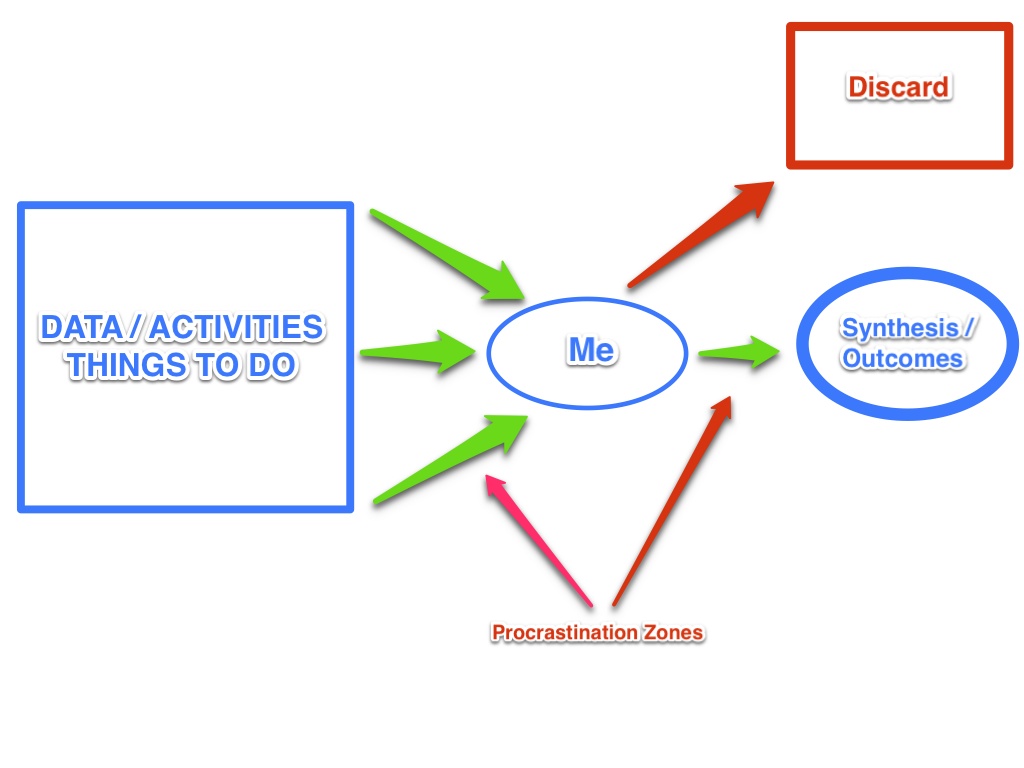
Fundamentally, though, I am not convinced that the volume of relevant information is that much greater than it ever was; the problem is determining relevance quickly—and then moving on. Thus, the single biggest challenge to efficiency? Procrastination.

For me, what I have noticed (in particular since my July 2009 about-face and decision to embrace Facebook and Twitter) is that there are two consistent—and generally well-meaning—procrastination zones that create problems, one as information is coming in, and the other as I’m pushing it out.

To address the problem in the first zone requires focus a heavier focus on relevance, and an effort to control (or curtail) digressions. This is the area where Facebook and Twitter can cause mayhem, along with all the things one needs to do for work (if not properly organized) or at home (like the non-tax-related papers one encounters on the way to doing one’s taxes).

The second zone demands a high-intensity focus on information management, managing both the flow of materials and the (rapidly proliferating) new toys tools to help get things done. For instance, I have been contemplating switching my meetings to a psychiatrist-style 50-minute hour, (or a 25 minute half-hour) in order to guarantee time between activities, during which I can write down or assign tasks, file papers, respond to email, etc. It’s the delaying of these small tasks that often create larger and more complicated tasks hours or days later.

There is no doubt that sometimes procrastination and digression can be beneficial; it is during this time that the stimulation of creativity and free associations can help solve problems or come up with new ideas. But digressions in the digital age seem are much worse, it seems: it’s too easy never to turn things off, to keep going, link by link, from dawn to dusk and back again.

And that’s fine, as long as it isn’t stopping you from doing what you need to do.

October 16th, 2011

Reading IS Fundamental

Last night, I sat next to my daughter in her room, she reading a Muppet book, and me reading Ashenden. Truth be told, I wasn’t getting a lot of reading done: every other minute, she asked me to help her make sense of a new word, so we would sound it out together, and then she would move on, and I would read another sentence until her next question. But at some point in this episode, much like Trixie, I realized something.

This was an extremely unusual scene.

The reading itself is not unusual. My daughter loves books and has from an early age; she’s the kind of kid who is quite likely to grow up to be a voracious reader. She has two shelves of books in her room, and another shelf of her own in the living room, and while she’s too young to articulate it this way, I think she takes pride in the books’ presence and what they offer: the opportunity to grab one and read it, no matter how familiar, and enjoy it all the same. I love books too, both the reading of them and the collecting of them, and have for as long as I can remember. I grew up surrounded by books, inherited libraries from people, and knew they were the one thing my father would always buy upon request. Books were and are essential to me. (The shift to the ebook is vexing, and very much a separate subject. But beyond the philosophical issues they raise is a simple, practical one: it feels not quite as authentic to catalog them when their very presence is so ethereal.)

So what was unusual about this scene? I realized that while I read constantly, I couldn’t remember the last time my daughter actually saw me reading a book, an actual book–and that saddened me quite a bit.

I am fairly sure she knows that I read books; our house is filled with them, and there’s a whole shelf and stack next to my side of the bed. She’s a smart girl, and my guess is that without ever thinking about it, she assumes I read those books just as she reads hers.

Yet that assumption isn’t the same thing is the literal, in-front-of-your-eyes knowledge of seeing your parents reading. It just can’t be. In an all-digital, iEverything age, the shared experiences of families takes a different form, and this whole thing gave me one more reason to feel slightly sad about its seeming inescapability. When I was young, I saw my parents reading all the time. Sure, they did other things too, but on a summer weekend afternoon, my dad was often inseparable from a book, or from one issue out of a stack of New Yorkers or New York Review of Books that he was trying to catch up on. I understood implicitly that this was an activity central to his life. I want my daughter to be able to say the same about me. Likewise, I want her to know the shared joy that comes from reading together–reading separate things, together, in the same place, whether it’s on a beach in summer or around a fireplace in winter, or just on a random evening at home.

With all these digital devices, her experience is different–as is mine, of course. I read, often, but holding my phone or my iPad I could just as easily be playing a game; there’s no book spine to give it away. Likewise, I spend time with these devices writing (as I am now, drafting on my iPad, editing on my laptop), and while she can discover these blogs when she’s older and look back with some understanding of what I might have been doing while typing away … I could just as easily have been sending a text message or an email or something else equally fleeting.

In theory, the fix for this should be easy: read more–more books, especially–around my daughter. This will likely be just as important for my younger son, who likes books but who could probably do with more evident modeling of the Life of a Reader. Talking more about books would help, too, to make evident the connection between their physical presence and our digestion of them. I love being a writer, and that’s an identity I would be happy to have my daughter understand–but as a writer, few things are as important as good readers. And as a reader, I want her to have the best shot I can provide at staying engaged with books for the rest of her life.